Arabian Landscapes: Desert Backgrounds for Creative Projects
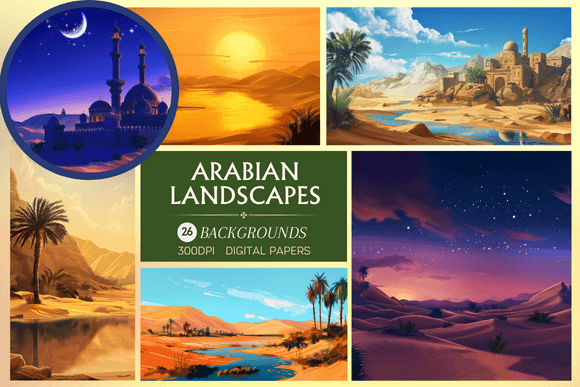
When working on a project that requires a specific cultural or atmospheric setting, finding the right background is half the battle. I recently integrated the Arabian Landscapes collection into my workflow, and it has changed how I approach designs for clients looking for that specific Middle Eastern aesthetic. This isn't just a random assortment of sand dunes; it is a curated set of 26 digital papers that capture the distinct architecture and natural beauty of the region. Whether you are a graphic designer building a brand identity or a crafter working on a scrapbook, these backgrounds provide a high-quality foundation that is often difficult to source.
The Visual Identity: Beyond the Sand Dunes
The first thing you notice about these backgrounds is the texture and resolution. At 300 DPI and 4000x2250 pixels, the detail is crisp enough for large-format printing. This is crucial if you are working on packaging design or physical invitations where pixelation can ruin the professional look. The collection moves beyond generic desert imagery. You will find intricate cityscapes, traditional mosques, and the warm, golden hues of twilight over the dunes. It strikes a balance between being culturally authentic and artistically versatile.
For designers focused on modern typography, these backgrounds offer a rich canvas. Because the landscapes are high-resolution, they allow text to sit comfortably on top without getting lost in visual noise. I have used them as backdrops for social media graphics and web design hero sections, where the image needs to convey a mood instantly. The color palettes are warm and inviting, ranging from deep terracotta and ochre to soft twilight blues. This makes them particularly effective for seasonal campaigns, especially during Ramadan, where the visual language needs to feel respectful and celebratory.
Practical Applications for Designers and Crafters
One of the strengths of the Arabian Landscapes collection is its adaptability across different mediums. As a designer, I look for assets that can serve multiple purposes to maximize value. Here is where this collection shines:
- Branding and Identity: If you are building a brand identity for a travel agency, a boutique hotel, or a restaurant specializing in Middle Eastern cuisine, these backgrounds are invaluable. They provide an immediate sense of place that helps establish the brand's story without needing a photoshoot.
- Editorial and Publishing: For editorial design, such as magazine covers or feature spreads, the high-resolution files hold up well against bleed and crop marks. They work beautifully for creating mood boards or as thematic backgrounds for text-heavy layouts.
- Crafting and Stationery: For the hobbyists and stationers, the applications are just as broad. The files are sized at 16:9, which is perfect for digital wallpapers or widescreen presentations, but they also crop well for standard card sizes. I have seen them used effectively in scrapbooking, where the vintage invitations style of some papers adds a layer of nostalgia to the project.
When it comes to logo design, I would advise caution. While the backgrounds are stunning, a logo needs to be versatile enough to work on a white background or a dark background. However, these landscapes are perfect for the "scene" in which a logo is presented—think of a mockup where your logo is placed on a product sitting against a desert backdrop. It adds context and storytelling to your portfolio.
Integrating with Typography and Design Assets
A background is only as good as the typography that accompanies it. When pairing fonts with the Arabian Landscapes collection, contrast is your friend. If the background features a busy cityscape, opt for a clean sans serif font to ensure readability. The geometric simplicity of a sans serif cuts through the organic shapes of the architecture.
Conversely, if you are using a background with a vast, open desert and a clear sky, you have more freedom to use a display font or a script font. A flowing handwritten font can evoke a sense of personal journaling or travel logs, which works well for blog headers or social media graphics. I often recommend testing your font pairings by placing the text in the lower third of the image, where the landscape is often less detailed, ensuring the message is the hero.
Evaluating Project Fit and Licensing
Before committing to any set of design assets, it is important to evaluate the specific needs of your project. These backgrounds are provided as JPG files, which is the industry standard for photography and raster images. However, remember that they are raster, not vector. This means you cannot scale them infinitely without losing quality, though at 4000x2250 pixels, you have a comfortable margin for most print and digital needs.
For commercial use, always verify the licensing terms. This collection is marketed for creative projects and commercial work, which is a significant advantage for small business owners. You can use these for your marketing materials, client work, or products you sell, such as printed stationery. It removes the legal headaches that come with sourcing images from the internet.
In conclusion, the Arabian Landscapes collection is more than just a set of pretty pictures. It is a functional toolkit for visual storytelling. It bridges the gap between digital and physical projects, offering the quality needed for professional publishing and the warmth needed for personal crafting. If your next project calls for a touch of the exotic or a specific cultural setting, this collection provides the visual shorthand to get you there efficiently.